Sunday, August 4, 2013

Regina RICA (Tanay, Rizal)


Due to Spanish colonization for more than 300 years, the Philippines remains as the top Christian country in Asia, wherein 90% of the population are Christians, and 80% of this Christian population are Catholics.

Given these data, it is but natural that the Philippines would boast of various spiritual pilgrimage sites across the nation, and these are being visited by the faithful especially during the Lenten Season.

According to Wikipedia: “A pilgrimage is a journey or search of moral or spiritual significance. Typically, it is a journey to a shrine or other location of importance to a person’s beliefs and faith, although sometimes it can be a metaphorical journey in to someone’s own beliefs.” 

When you talk about pilgrimage venues in the island of Luzon, the “Our Lady of Manaoag” in Pangasinan, “Our Lady of Peñafrancia” in Naga City, and the “Our Lady of Peace and Good Voyage" in Antipolo, would definitely enter into our minds as Pinoys.

Let us now take a closer look at one of the least popular pilgrimage areas on this island: the Regina RICA in the province of Rizal. 

The Regina Rosarii Institute for Contemplation in Asia or simply Regina RICA is a venue for serenity, silence and stillness in this noisy and harried world. It is a 13.5 hectare land in the hills of Tanay, Rizal, Philippines envisioned by the Dominican Sisters of Regina Rosarii to be a place of pilgrimage, prayer, contemplation, ecological sanctuary and wellness environment. 

Arriving at the site last July 28, 2013 after more than two hours from Quezon City, since we traveled using a car, we paid the parking fee worth Php 50.00. There is no Entrance Fee at Regina RICA, but donations are welcome.

Entering the Souvenir Shop area, which was near the parking area, we entered our names in the Registration Folder situated at the counter.


The Registration Folder

Based on blog readings, since the place contained loads of interesting places, they stated that there would be free copies of the venue map so you would know your way around. Unfortunately, they already ran out of copies when my time came…ouch! So, for those who will be trekking to this place, make sure you download the venue map as seen below:

Venue Map

We were provided each a welcome drink of Tarragon Tea, which was good for blood cleansing.

Welcome Drink:Tarragon Tea

Since we were all first-timers to the place, we attended an orientation provided by RICA Volunteers for us to know what would we see and expect, as well as the rules of the compound.

Orientation Room

The first part of our “journey” was trudging the so-called S-trail of the El Shaddai Hills consisting of 308 steps and 13 candle stations going towards the 71-foot tall statue of the Blessed Virgin Mary.

Trudging the S-trail

For those who believe that they could not climb these steps, there is a shuttle that can take you to the statue for a payment of only Php 5.00.

Arriving at the top, you will be amazed at the statue, and when you turn your back, you could view the Sierra Madre mountains as well as the Regina Rosarii Chapel.

Beneath the 71-foot statue...amazing!

Sierra Madre mountains & Regina Rosarii Chapel behind me

Beneath the statue, there will be a brief orientation before you are allowed to enter the Sanctuary of Universal Love and Devotion or SULOD. The SULOD is located inside the enormous statue, and photography and all kinds of footwear are prohibited in this adoration chapel. 

Various footwear...all in a row

Located at the back of the statue is the Pilgrims’ Labyrinth. It is used as an avenue to pray as they walk towards the center, symbolizing man's search for God at the center of their being. It is a journey of meditation. On the left side of it is the Tilipunan (Gazebo), an Ilonggo word for Gathering Place.

Pilgrims' Labyrinth w/ the Tilipunan on the left side

Walking downhill towards the Regina Rosarii Chapel, I passed by a few “Way of the Cross” markers, as the Holy Mass started at 11:00 AM. A huge Dominican Star can be seen in front of the Chapel.

A "Way of the Cross" marker

Regina Rosarii Chapel from outside


Inside the Regina Rosarii Chapel

After the Mass, there was a long line of devotees at the altar since there was a Healing & Adoration of the Holy Relic.

At the back of the Chapel is the Multi-Purpose Hall where you could see religious statues.

One of the statues

As we continued further downhill, we arrived at the Rotunda de San Jose, which displays a 13-foot statue of St. Joseph looking at his family from a distance.

 
Rotunda de San Jose

With hunger starting to poke on us, we then trudged uphill towards the Handong, an Ilonggo word for Shady Area, where a restaurant, also called Pasilungan, was located.

Handong

Again, as you enter, you can have a dose of a complimentary drink, and yes…you guessed it right…Tarragon Tea.

Welcome Drink (again):Tarragon Tea

To avoid the time-consuming hassles of looking at the menu and deciding what to eat, we just opted to order the Complete Meal package for the day worth Php 200.00 per head. When it arrived at our tables in just a few minutes…wow…the one-serving meal can even accommodate two customers. By the way, Regina RICA only serves vegetarian dishes. Do not forget to order their Maiz Con Yelo (Php 60.00)…sarap!
 
Menu For Today

The Complete Meal we ordered
Maiz Con Yelo
Kodakan muna before Pasilungan departure

Returning back to the Souvenir Shop, we now bought souvenirs as pasalubong for our folks and for our personal property.

Some items @ Souvenir Shop

By the way, for those who would want to experience food sourced from organic vegetables and fruits, there is a stall at the Souvenir Shop where you could purchase these. 
 
Vegetarian Snack Bar

A wacky departure pictorial with Regina RICA staff

As far as pilgrimage or contemplative places are concerned, Regina RICA would definitely not be one of the preferred venues for soul-searching for the majority, since it is barely being promoted or advertised, therefore would not become a by-word for a lot of religious travel enthusiasts out there.

Given this form of promotion in this site, why not give it a try?

You do not have to wait for the season of Lent to visit this magnificent place.

It is worth the trip...Explore Pinas!

Thursday, August 1, 2013

Sagada & Banaue (Mountain Province) Part 2 of 2


May 19, 2013 (Sunday) 

After waking up very early with an ultra aching body, obviously coming from the advanced spelunking, we went to the Church of St. Mary the Virgin to attend the Holy Mass at 6:30 AM.

Church of St. Mary the Virgin

The church was established by American Protestant Missionaries in 1904. About 95% of the town of Sagada are baptized into the Protestant faith.

Offertory Collection Bags

Inside the church, you could see several friendly dogs roaming around, and one of the features I saw in this venue is that they have booklets situated on the pews, one contains the various chronological order of the Mass depending on certain occasions, and the other booklet houses all the Mass songs. These booklets are used daily that is why you should return them after use, a far cry from the Missalettes we use on a given day only.  

The Booklets

On the left side, facing the altar, you could spot the organist, with numbers in front of him, signifying the page numbers of the songs in the booklet that would be used for this day's Mass. He announces the page numbers through a microphone beside him whenever he would start playing a given song.
 
The Organist

An attest of how close-knit the Sagada Parish community was when during the Homily portion, since me and my friends sat on the first few rows, the young Parish Priest noticed us that we were "tourists", and he welcomed us to their community.

Altar Shot with the Parish Priest

Departing from the church, we headed to Cafe Bodega at the Rock Inn for breakfast, wherein I ordered Farm Rice w/ Bacon & Egg (Php 195.00) and Pineapple Juice. The meal was so good, but the quantity was overwhelming for a breakfast meal made for one serving...mabuti malaki ang kaha ko...burp!  


Main Entrance of Cafe Bodega

Farm Rice w/ Bacon & Egg and Pineapple Juice

The breathtaking Bomod-Ok (Big) Falls was the next stop, but since I still had bodyaches from yesterday’s undertaking, I passed on this one since, according to the guide, the whole trek would take several hours with some uphill trudges to boot. Lucky them, and while I was waiting for some of my companions to complete that trek, me and some of my “co-weak” friends decided just to do some street walking and souvenir shopping, and then went to the guest house to pack our stuff and get some rest.

Bomod-Ok Falls (the one I missed....argh!)

We bade farewell to the guest house at 2:00 PM and went for lunch at the Salt and Pepper Diner as a heavy downpour occurred. Nevertheless, the Mushroom Inutom w/ Potato (Php 195.00) was unique and delicious! 

A Guest House Farewell! 
Mushroom Inutom w/ Potato @ Salt and Pepper Diner

Well, since we were already at the vicinity of the Mountain Province, there is nothing grander to cap off the entire trip than to visit the world-famous Banaue Rice Terraces.

The van made its long way towards that destination via Bontoc than Banaue. The route we took was a marvel for the eyes as we saw astounding displays of nature at its peak…literally. Yes, some parts of the highway would really take you to soooo above sea level.

When we arrived at the main viewpoint of the Banaue Rice Terraces at 6:00 PM, we quickly bolted the vehicle for kodakan galore since the sun would disappear in several minutes.

Banaue Rice Terraces

The Banaue Rice Terraces are 2,000-year old terraces that were carved into the mountains of Ifugao in the Philippines by ancestors of the indigenous people. The Rice Terraces are commonly referred to by Filipinos as the "Eighth Wonder of the World". 

Leaving the site, we saw along the road that households in Banaue mostly do not have electricity. We could either see homes with a few candles or none at all, and that was around 7:00 PM.  Were they already sleeping that early? Whoah!

The Sagada experience would only be enjoyable for those who love nature as well as thrill-seekers. If you are tired of the passive aura of Baguio, why not level-up and proceed to the active side of Sagada and experience a different Mountain Province world. 

Never ever leave Sagada without eating their vegetables and bring loads of cash…Explore Pinas!   

Wednesday, July 31, 2013

Sagada & Banaue (Mountain Province) Part 1 of 2


During the summer season, loads of people generally flock to the Mountain Province in Luzon, most especially the so-called summer capital of the Philippines, which is Baguio, in order to leisurely enjoy the cool weather amidst the sweltering heat of some areas in the country.

Nothing beats a slow-paced environment in Baguio with much less heat, just enjoying the other side of the coin, outside of school and work life. For me, this area is for passive Mountain Province enthusiasts, but if you are the kind who would want to experience the active side of this region, it has got to be Sagada.

Since I have been to Baguio several times, I then decided that at 41, I believe it was time for me to move one notch higher and finally experience Sagada while my bones were still that competent hahaha.


May 17, 2013 (Friday)

Me and my officemates rode the employee shuttle after office at 5:00 PM and we alighted at the Trinoma Mall in Quezon City around 6:00 PM, as our rented van awaited at the external parking area.

We departed the Trinoma area at 7:00 PM and had dinner at Chowking inside the Petron NLEX station in Marilao, Bulacan.


May 18, 2013 (Saturday) 

After several hours on the road, a minor “tragedy” struck. While along the dark stretches (it’s already early morning) of Kennon Road, the driver discovered that we had a flat tire, and after replacing it with a spare tire, the van headed to a Baguio City vulcanizing outlet in order to ensure a safer trip.

Departing Baguio City towards our destination, as the countdown to sunrise ticked on, you could really see the breathtaking view of the rest of the Mountain Province and feel the cool breeze as we opened our windows to fathom God’s work amidst the numerous zigzags we encountered along the way. This is the “other side” of Baguio…a must-see for every Baguio-only traveler!

At the stroke of 5:00 AM, we were now in Sagada heaven!

As the van traversed its way along Staunton Road and entered the Kiltepan Road, we hurriedly left the parked vehicle and headed towards the so-called Kiltepan Viewpoint, where a lot of tourists have already gathered as they wait for the sun to shine, since this place is where you can be able to view the best sunrise in Sagada.

Cameras began to flash at 5:35 AM as nature opened its curtains to unveil the famous Kiltepan Sunrise…simply spectacular!

The Kiltepan Sunrise


After checking-in at George Guest House, we decided to have breakfast at the well-known Sagada Lemon Pie House along South Road, but unfortunately, to our dismay, they already ran out of breakfast meals (huwaaaaat…it was just 7:00 AM), so we left and I ate Tapsilog at George Guest House instead, amounting to Php 100.00 and Mineral Water for Php 25.00.

George Guest House


You said it right, meals in Sagada are expensive!

With a “newfound energy” now flowing in all our systems, we then headed to the famous Sagada caves for a morning dose of spelunking.

Our guide, who is a member of the Sagada Environmental Guides Association, told us that our “exploration” would be the “Lumiang and Sumaguing Cave Connection” path, and it would take us around four hours to complete, so we all agreed, thinking that this path was the one most tourists experience.

At the entrance of the Lumiang Cave, you can view at least 200 coffins that have been there for 500 years. Family members or friends of the dead would pass and take turns in transporting the coffin to the cave. They believe that when the one that carries the coffin is stained with the dead’s blood, he gains good fortune and blessings in life. 

Coffins @ Lumiang Cave


It was noticeable that the coffins were a little small for a full-grown adult because the dead should be forced to a fetal position in order to fit in the coffin. Since they all came from a fetal position in the womb, they too must “rest” in the same position. 

While most of the coffins are piled one after another, there are also coffins tucked in the highest upper corners of the cave wall. It is unthinkable how the families were able to get the coffin all the way up there, but this signifies the families’ effort out of love for the deceased. 

Some of the coffins which have carvings of a gecko (the reptile Sagadians revere for guarding their harvests) are those described as highly-respected leaders. 

In addition, this cave contains the bones of old people who died of natural causes. There is a separate site for burying young people, since they were expected to have done more things in this world.

As we continued our torturous route, after finishing around 25% of the entire journey, churning our bodies from small rock openings, as well as rappelling in one juncture, we only knew then that the kind of activity that was catered to us was for the expert level…ouch!

A picture of exhaustion...huffing and puffing


Since it was totally impossible for all of us to go back due to the difficulty of the path, we had no choice but to proceed…whew! 

Lumiang Cave is the alternative passageway to those people who want mental and physical fatigue going to Sumaguing Cave. Starting at the Sumaguing Cave is for beginners, while starting at the Lumiang Cave is for advanced spelunkers. 

Going back to the unexpected “ordeal”, aside from the type of activity previously mentioned, we also experienced very slippery rocks, climbed a 10-foot rope, and immersed our entire bodies in super duper cold water. Yup, you could really perform the unimaginable when your own survival is at stake hahaha. Yes, if you do not follow your guide to the letter, you would really might end up as part of history, and I really do mean it.

Crossing super cold water...brrrrrrr!

"Rice Granary" rock formation
Cautious due to slippery rocks


Also, for the “delicate” types, Sagada caving is definitely not for you, since there were loads of instances where you would have to sit or hold on to bat droppings called Guano.

After almost four hours (9:33 AM to 1:23 PM), crossing from the Lumiang Cave up to the Sumaguing Cave, we quickly sat on some rocks after the cave’s exit totally drained, exhausted, and hungry. One thing’s for sure…I went through an expert level caving adventure and conquered it…yeah!    

4-hour advance level spelunking...done!

A much much needed rest!
 
For those who want to experience the Sagada caves, wear slippers or just go barefoot due to the presence of slippery rocks along the way. Sporting trekking shoes or trekking sandals would still make your spelunking more difficult.

Before we departed from the place, we bought souvenirs from the shop just outside Sumaguing Cave, and then went straight to the “Yoghurt House” for lunch. I ordered the Java Chicken with Salad and Plain Rice (Php 190.00) and Pineapple Juice (Php 40.00), and for dessert, the best-selling Banana with Strawberry Yoghurt (Php 85.00). Love the food especially the veggies!

Yoghurt House

Java Chicken w/ Salad and Plain Rice

Banana w/ Strawberry Yoghurt


Our next stop was Echo Valley, but before seeing that place, you would first enter the Anglican Mission Compound, and be welcomed by the 1921 Centennial Bell, a landmark in Sagada’s history, which is the most photographed church bell of Sagada stamped A.D. 1921. It is located at the back of the Church of St. Mary the Virgin. You would also come across a large wheel which was placed on Sagada on October 11, 2001 as a centennial marker for 100 years of mission and ministry of the Episcopal Church in the Philippines. The wheel was previously part of a sawmill brought by the United States to Sagada. When the mill stopped operating, the wheel was discarded and left lying on the ground for almost a century. It found its second life in showbiz as a famous Sagada landmark.

1921 Centennial Bell

Centennial Marker Wheel

A few walks after passing by the Sagada Anglican Cemetery, where Christians who passed away were buried in a Christian Cemetery, there is a narrow trail leading to a cliff called the Echo Valley, a place  where you could shout and the echo produces loud sounds. At this point, you could also view from a distance the most popular  tourist spot in the Mountain Province, the Hanging Coffins of Sagada.

Sagada Anglican Cemetery

Echo Valley

Hanging Coffins on the right side at a distance

This is a traditional way of burying people that is still being done up to the present, but not everyone is qualified to be buried this way; among other things, one had to have been married and had grandchildren. Also, as per Igorot tradition, the only ones permitted to be placed inside the hanging coffins are those who have died from natural causes, especially due to old age. 

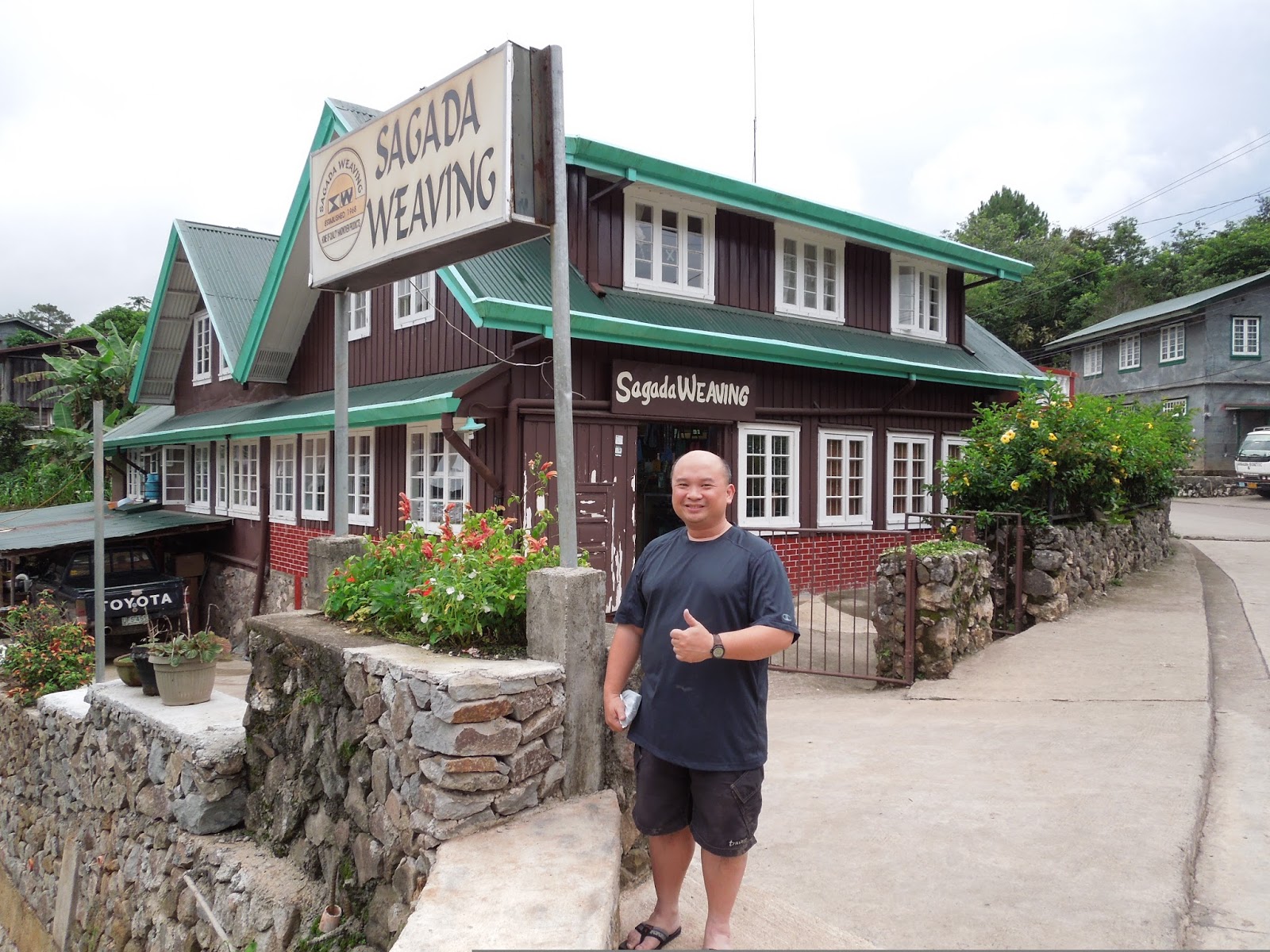
Our next destination was a place called “Sagada Weaving”, which started way back 1968. A pioneer of weaving products in Sagada, it utilizes looms to produce quality hand-woven fabrics fashioned into functional bags and apparel. This is one of the must-see venues for souvenir shopping. 

Sagada Weaving


We then proceeded to the Misty Lodge and Café for our dinner, a place famous for their burgers and pizzas, as stated in various travel blogs. In here, I ordered the Bacon Lover’s untry Fries (Php 190.00) and Lemon Grass Tea (more than Php 30.00). Great tasting burger!
 
Misty Lodge and Cafe here I come!


Bacon Lover's Burger w/ Country Fries and Lemon Grass Tea

Sagada & Banaue (Mountain Province) Part 2 of 2